


Page 59 - Flytxt
P. 59
contains some specific object, feature or            corresponding to each image. DAISY
          an activity of interest.                             features associated with key points


          Excitingly, Flytxt is now pitching in to             within images as the local feature
          solve this problem. The Data Science                 descriptor (similar to SIFT features) and
          R&D team at Flytxt has released an                   histogram of oriented gradients (HOG)

          end-to-end scene recognition pipeline                corresponding to an entire image is used
          consisting of feature extraction,                    as a global descriptor.

          encoding, pooling and classification.                As images vary in view point, scale,

          The primary objective of this project is to          orientation, illumination and occlusion

          clearly outline the practical                        level of objects, extracting robust
          implementation of a basic scene-                     features (such as DAISY, SIFT, HOG etc.)
          recognition pipeline having reasonable               to represent them is critical for building

          accuracy, using conventional computer                an effective image classification model.
          vision techniques (without applying deep             As the number of key points vary across

          learning techniques) in Python, using                images, multiple DAISY descriptors would
          open-source libraries.                               exist for each image. We use a bag-of-


          How  the  Flytxt  model  works                       visual-words concept to encode each

          To enable accurate recognition, Flytxt               image as a histogram of dimensionality
                                                               ‘K’ (where K is the vocabulary size or the
          R&D team simultaneously utilizes

          global feature descriptors as well as                number of possible “visual words”).
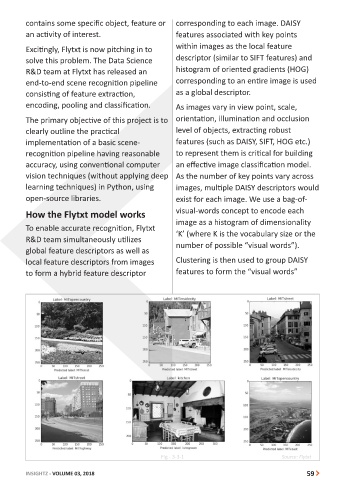
          local feature descriptors from images                Clustering is then used to group DAISY

          to form a hybrid feature descriptor                  features to form the “visual words”


                                                          Fig - 3-3-1                               Source: Flytxt


          INSIGHTZ - VOLUME 03, 2018                                                                         59

